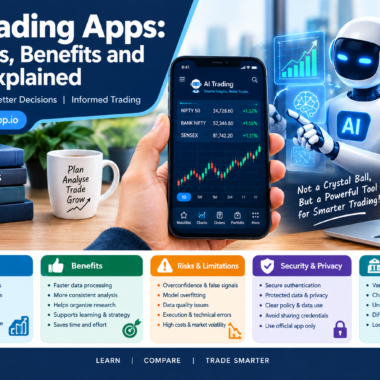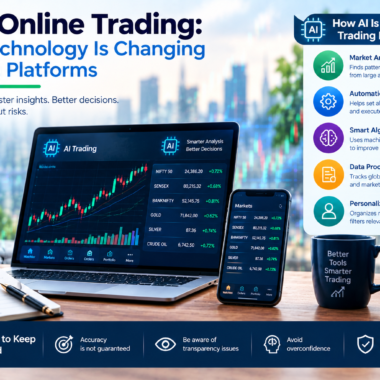
Modern financial markets and Traders Analyse Market Data produce an enormous amount of information every day. Price movements, trading volume, technical indicators, company announcements and economic developments can all affect a market. For an individual trader, reviewing every data point manually can be difficult. Artificial intelligence can help organise and analyse information, although it does not eliminate uncertainty.
Understanding Market Data
Market data includes information such as current and historical prices, volume, volatility, open interest and other market statistics. Traders use this information to understand how an asset has behaved and to build a trading plan.
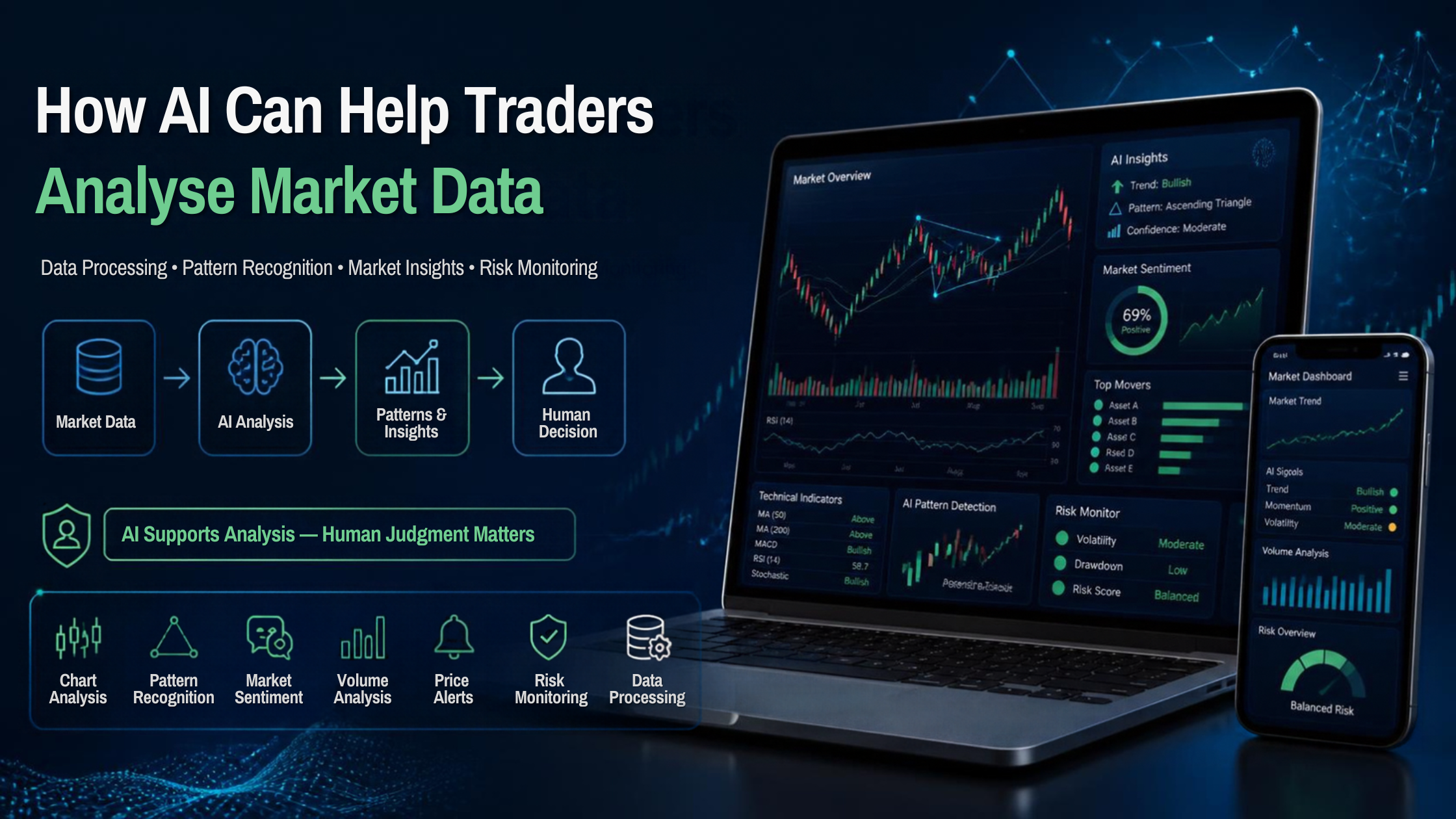
AI systems can process large datasets quickly. Instead of manually reviewing hundreds of observations, a trader can use an AI-supported workflow to filter information and identify areas that deserve closer attention.
Pattern Recognition
One common application of AI is pattern recognition. Algorithms can compare current market conditions with historical data and identify similarities in price behaviour, volatility or volume.
This can support research, but a historical pattern is not a guarantee of a future outcome. Market conditions can change, and patterns that appeared useful in one period may perform differently later.
Technical Analysis Support
AI can also assist with technical analysis. A system may combine indicators such as moving averages, relative strength measures, momentum readings or volatility measures and present the results in a structured format.
The benefit is often speed and organisation. Instead of switching between multiple charts, traders may receive a consolidated view. The final interpretation still requires an understanding of the indicators and their limitations.
News and Text Analysis
Financial markets react to information from companies, governments, central banks and economic institutions. AI-based language tools can help summarise long documents or classify information by topic.
For example, a trader researching a company may use an AI system to organise an earnings release into sections such as revenue, expenses, guidance and major business updates. The original source should still be checked before acting on a summary.
Alerts and Monitoring
AI can help traders monitor selected conditions. An alert may be triggered when price volatility increases, volume changes sharply or a predefined combination of indicators occurs.
Such alerts can reduce the need for constant manual observation. They should be treated as information for review rather than automatic proof that a trade should be placed.
Managing Large Amounts of Data
A major advantage of AI is its ability to process structured information at scale. Traders researching several instruments can use automated screening to narrow a large universe into a smaller list for detailed analysis.
This can save time, particularly when the screening rules are clearly defined. Poor-quality data, however, can produce poor-quality results.
Backtesting and Strategy Research
AI can also be used in strategy research and backtesting. Historical data can be used to test whether a set of rules would have produced certain results in the past.
Backtesting has important limitations. Historical performance does not guarantee future results, and an overly complex model can fit past data without working well in live conditions.
Human Oversight Remains Important
AI should not be treated as an independent decision-maker. A trader should understand what information a model uses, what assumptions it makes and where its limitations lie.
Risk management also remains necessary. Position sizing, diversification where appropriate, trading costs and potential losses should be considered before entering a position.
Using AI Responsibly in India
Traders in India should also distinguish analytical technology from the legal and regulatory status of the trading service. SEBI describes dabba trading as illegal and unregulated because transactions are not executed through recognised stock exchanges. citeturn0search0
An AI interface does not change the regulatory status of an underlying trading arrangement. Users should verify the intermediary and the services being offered before depositing funds or placing trades.
Conclusion
AI can make market analysis faster by helping traders filter data, identify patterns, summarise information, monitor conditions and test strategies. Its value depends on data quality, model design and appropriate human oversight.
Used carefully, AI can support research without replacing the trader’s responsibility to understand risk and verify information. The goal should be better-informed analysis rather than an assumption that technology can predict every market move.